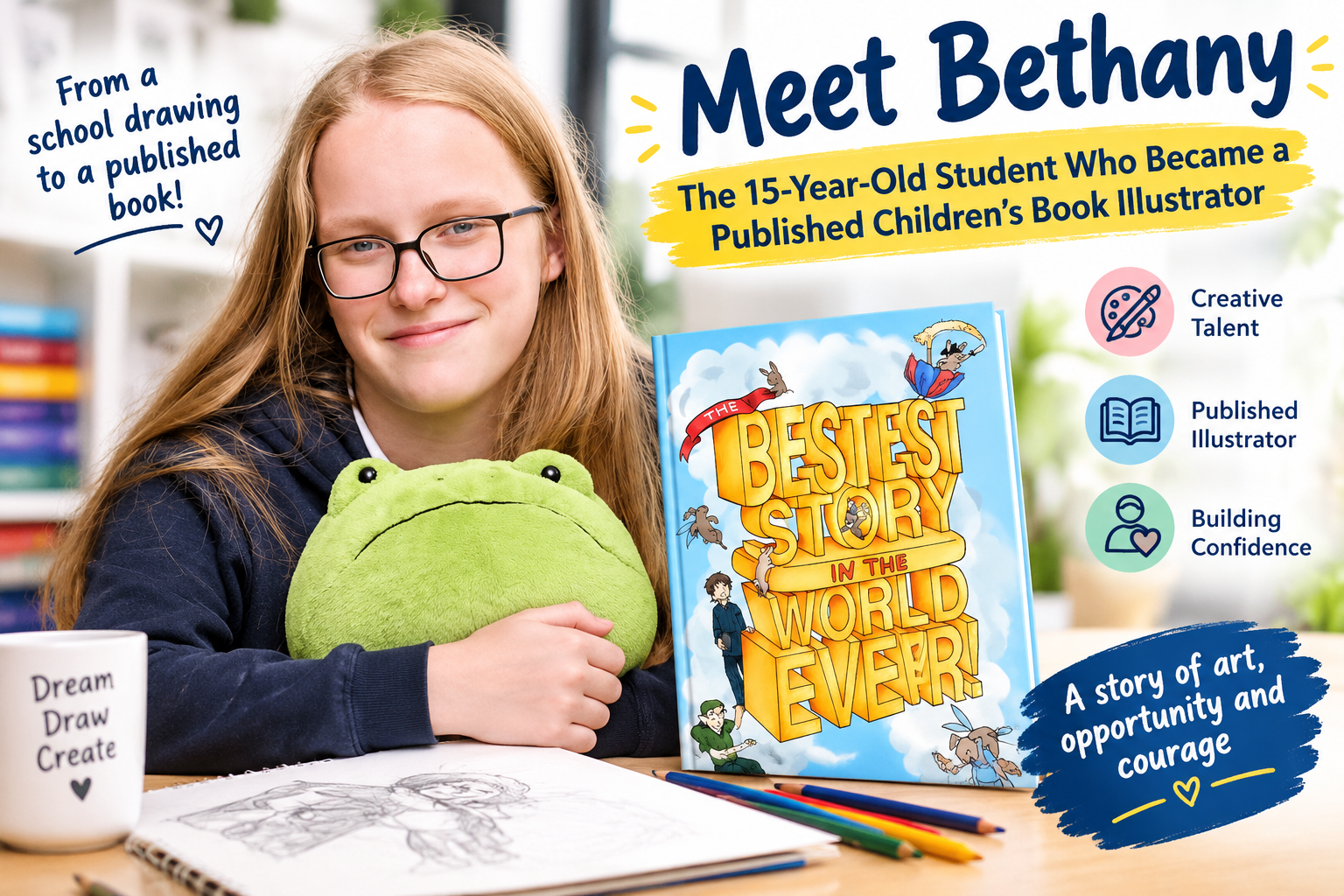
Meet Bethany: How a 15-Year-Old Student Became a Published Children’s Book Illustrator
A 15-year-old student from Cambridgeshire, England, is attracting attention for her artistic talent and inspiring personal journey. Bethany became a published children’s book illustrator after a portrait she created during a school storytelling session caught the attention of author and storyteller Chip Colquhoun.
For Bethany, drawing was initially a way to concentrate during the session. However, that simple activity opened the door to a creative opportunity that helped her share her abilities with a wider audience.
Bethany experiences situational mutism, a condition that can make speaking difficult in particular social settings. Despite these challenges, her illustration work has helped her explore new experiences, develop confidence and work on professional creative projects while continuing her education.
How a School Drawing Changed Bethany’s Journey
Bethany’s journey into children’s book illustration began when storyteller and author Chip Colquhoun visited her school to conduct a storytelling session.
While listening to the session, Bethany started sketching a portrait of Colquhoun. She explained that drawing helped her focus, and she needed something to sketch while following the presentation.
Her artwork soon caught the author’s attention. Impressed by her talent, Colquhoun recognised an opportunity to encourage the young artist.
The portrait subsequently appeared in a book that offered educators guidance on using storytelling as a teaching tool. The experience also led to a larger assignment: illustrating a children’s book.
This opportunity demonstrated how a student’s everyday creative activity can sometimes lead to unexpected possibilities when someone recognises and supports their abilities.
Bethany Becomes a Published Children’s Book Illustrator
Bethany went on to illustrate The Bestest Story in the World Ever!, a children’s book written by Chip Colquhoun and published in September 2026.
Seeing her artwork printed in a published book was a new experience for the teenager. She described the feeling as unusual and almost unreal.
The project also gave her an opportunity to develop her illustration skills and understand how artwork contributes to children’s storytelling.
Book illustrations are an important part of children’s literature. They help young readers imagine characters, understand events and connect with a story. For an illustrator, creating images that complement a writer’s ideas requires imagination, attention to detail and an understanding of the intended audience.
Bethany’s work has attracted praise from other illustrators, according to Colquhoun. Her experience highlights how young artists can begin developing a portfolio through real creative projects.
How Illustration Helped Bethany Build Confidence
One of the most important aspects of Bethany’s story is the change she has experienced in her confidence.
Bethany lives with situational mutism, also known as selective mutism. People with this condition may find themselves unable to speak in certain situations, even when they have developed normal language skills.
Bethany explained that speaking could be easier with some people but difficult with unfamiliar individuals or in uncomfortable surroundings.
Her mother, Fiona, has also described how anxiety can affect her daughter’s ability to communicate. Although Bethany has made progress, the condition continues to influence aspects of her everyday life.
Working as an illustrator has given Bethany a way to share her talents without relying entirely on spoken communication.
Her growing experience has encouraged her to attempt activities that once felt overwhelming. These include attending book launches and participating in radio interviews with support.
The progress does not mean that all her difficulties have disappeared. Instead, it shows how encouragement, appropriate support and opportunities can help someone take gradual steps towards greater confidence.
Understanding Situational Mutism
Situational mutism, commonly called selective mutism, is an anxiety-related condition in which a person may be unable to speak in particular social situations despite being able to speak in other settings.
It should not automatically be interpreted as a lack of knowledge, unwillingness to communicate or poor language ability.
The condition can affect school participation, social relationships and everyday activities. Experiences vary from person to person, and appropriate support can be important.
Bethany’s experience illustrates some of these challenges.
| Aspect | Details |
|---|---|
| Condition | Situational or selective mutism |
| Main difficulty | Speaking in certain social situations |
| Possible contributing factor | Severe anxiety |
| Impact on daily life | Communication and unfamiliar activities may be difficult |
| Bethany’s creative outlet | Drawing and children’s book illustration |
| Support system | Family, educators and creative collaborators |
Her story also offers an important reminder: people have different ways of expressing their ideas and abilities. Supportive environments can help young people participate at a pace that works for them.
Balancing Schoolwork With Professional Illustration Projects
Despite her growing creative commitments, Bethany continues to manage her schoolwork.
According to the report, she is working on illustrations for another book and has three additional drawings to complete for a separate project.
Bethany has developed a routine that allows her to divide her time between education and art. She generally works on illustrations around 8 pm or 9 pm, while arranging her schoolwork around the times when she feels more productive.
Balancing academic responsibilities with creative projects requires planning, consistency and realistic time management.
For students who want to develop artistic skills, her journey highlights several useful lessons:
- Practise regularly: Small drawing exercises can help improve artistic skills over time.
- Build a portfolio: Keeping completed artwork together can help demonstrate progress and creative ability.
- Explore opportunities: School activities, storytelling sessions and creative competitions can provide valuable learning experiences.
- Manage time carefully: A consistent routine can help students balance education with personal interests.
- Accept encouragement: Feedback from teachers, family members and experienced professionals can help young artists develop.
These steps do not guarantee professional success, but they can help students explore their interests and build useful skills.
Book Launches and Radio Interviews Mark New Milestones
Bethany’s work has also introduced her to experiences outside the classroom.
Her mother said she had attended two book launches and taken part in interviews with two radio stations. These events represent meaningful milestones for a teenager who continues to need support in unfamiliar environments.
Such experiences can provide opportunities to meet readers, learn about the publishing industry and understand how creative work reaches an audience.
For Bethany, the value of these achievements goes beyond seeing her name associated with a published book. They have also allowed her to attempt activities that might previously have felt too stressful.
Her journey shows that confidence can develop gradually. Progress may involve trying something new with help rather than overcoming every difficulty at once.
What Bethany’s Story Teaches Students and Young Artists
Bethany’s experience offers an encouraging message for students, parents, teachers and aspiring artists.
First, talent can emerge in ordinary situations. Her illustration journey began with a drawing made during a school activity, not with a formal plan to enter the publishing industry.
Second, recognising a young person’s strengths can create opportunities for development. Colquhoun’s response to her portrait helped turn a personal interest into a published creative project.
Third, personal challenges do not define a person’s entire potential. Bethany continues to experience difficulties associated with situational mutism, but she is also developing her skills and taking part in new experiences.
Finally, support matters. Family encouragement and opportunities to work with others have helped Bethany explore activities that were once difficult for her.
Bethany’s journey from sketching a school storyteller to becoming a published children’s book illustrator is an inspiring example of how creativity can open new doors.
Her work with author Chip Colquhoun has given her opportunities to develop her artistic abilities, contribute to children’s literature and gain confidence through new experiences.
Although situational mutism continues to affect her daily life, Bethany is moving forward with her creative projects while balancing school responsibilities.
Her story reminds us that young people should be encouraged to explore their interests and develop their strengths. Sometimes, a simple drawing can become the beginning of a much bigger journey.